

[ad_1]
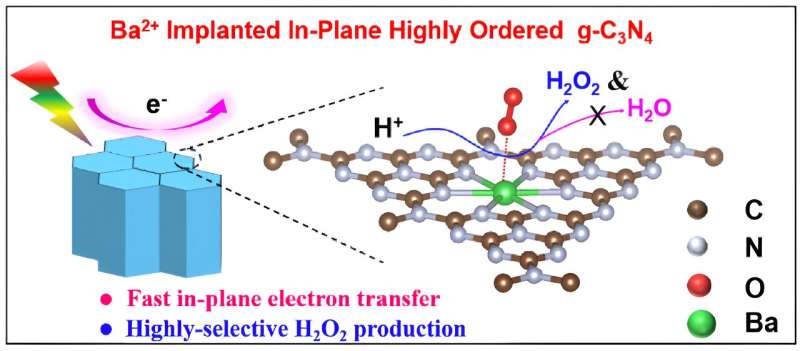
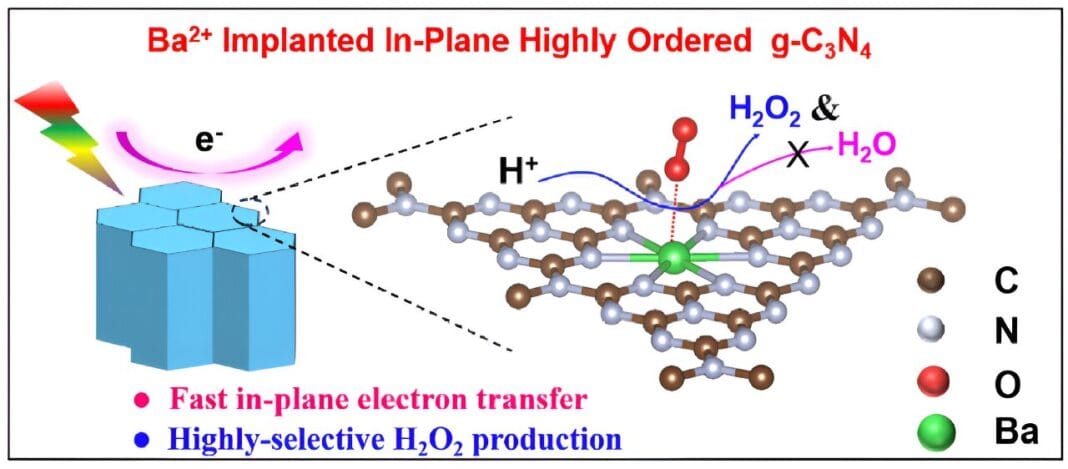
Photocatalytic H2or2 manufacturing utilizing solely water and oxygen as substances is a sexy and sustainable technique to switch the standard anthraquinone course of. Use of BaCl2-mediated in-plane polymerization technique, the researchers synthesized a novel Ba-implanted graphitic carbon nitride photocatalyst with extremely distinctive ordered nanorod constructions, which exhibited a boosted photocatalytic H2or2– charge of evolution. This innovation paves the way in which for a greener and extra environment friendly H2or2 manufacturing course of. Credit: Chinese Journal of Catalysis
H2or2, a inexperienced oxidant and clear gasoline, is in excessive demand in chemical industries, environmental therapies, and even aerospace. However, conventional manufacturing strategies depend on energy-intensive processes that aren’t environmentally pleasant. Scientists are searching for a greener different, and semiconductor photocatalysis that makes use of photo voltaic vitality to drive chemical reactions has emerged as a promising answer.
Currently, numerous photocatalysts, similar to TiO2BiVO4metal-organic complexes and natural polymers, analyzed for H2or2 photosynthesis. Cost-effective graphitic carbon nitride (gC3N4) has gained widespread consideration in H2or2 photosynthesis due to its elemental abundance, excessive construction stability and correct band construction.
However, the H2or2 manufacturing effectivity of conventional gC3N4 severely restricted by the poor crystallinity and selectivity of the two-electron oxygen discount response (2e–-ORR). Therefore, the development of the in-plane crystallinity of bulk gC3N4 is crucial to sufficiently set off the oxygen discount response for environment friendly photocatalytic H2or2 manufacturing.
Recently, a analysis group led by Prof. Yaorong Su from Shenzhen Technology University, China, cleverly overcame these obstacles. They developed a brand new sort of photocatalyst, in-plane ordered gC3N4 nanorods with barium (Ba) atoms implanted. This innovation not solely enhances the in-plane crystallinity but in addition induces a extremely selective 2e–-ORR, which is the important thing to environment friendly H2or2 manufacturing.
Ba-implanted nanorods work their magic by altering the way in which oxygen molecules (O2) work together with the photocatalyst. Instead of the standard side-on binding that favors water manufacturing, Ba atoms encourage extra favorable end-on binding. This change considerably reduces the potential for OO bond breaking, successfully suppressing the competing four-electron response and enhancing the manufacturing of H2or2.
A outstanding 6.1 instances enhance in H2or2 manufacturing charge in comparison with the unique gC3N4 achieved. This achievement not solely optimizes the photocatalytic means of photo voltaic energy-driven H2or2 photosynthesis but in addition opens up new potentialities to design environment friendly catalysts for solar-to-fuel conversion, bringing us nearer to a sustainable future.
This work was revealed in Chinese Journal of Catalysis.
More info:
Aiyun Meng et al, Towards probably the most selective H2or2 photosynthesis: In-plane extremely ordered carbon nitride nanorods with Ba atoms implantation, Chinese Journal of Catalysis (2024). DOI: 10.1016/S1872-2067(24)60008-2
Awarded by the Chinese Academy of Sciences
Citation: Solar energy-driven H₂O₂ photosynthesis from water and oxygen utilizing Ba-implanted ordered carbon nitride (2024, July 15) retrieved 15 July 2024 from https://phys.org/information/2024-07-solar-energy -driven-h8322o8322 -photosynthesis.html
This doc is topic to copyright. Except for any honest dealing for the aim of personal research or analysis, no half could also be reproduced with out written permission. Content is offered for informational functions solely.
[ad_2]
Source link