

[ad_1]
From pv journal 05/24
On January 31, 2024, researchers from the Fraunhofer Institute for Solar Energy Systems (Fraunhofer ISE) introduced that, along with perovskite developer Oxford PV, they’ve developed a full-sized perovskite tandem module with a conversion effectivity of 25%. At 421 W, the ability output of the dual-glass module is much from that obtained by the large-format modules produced by the giants of the photo voltaic trade. However, the result’s a robust demonstration of the steps being taken to commercialize what’s broadly thought-about to be the following technology of photo voltaic cell expertise.
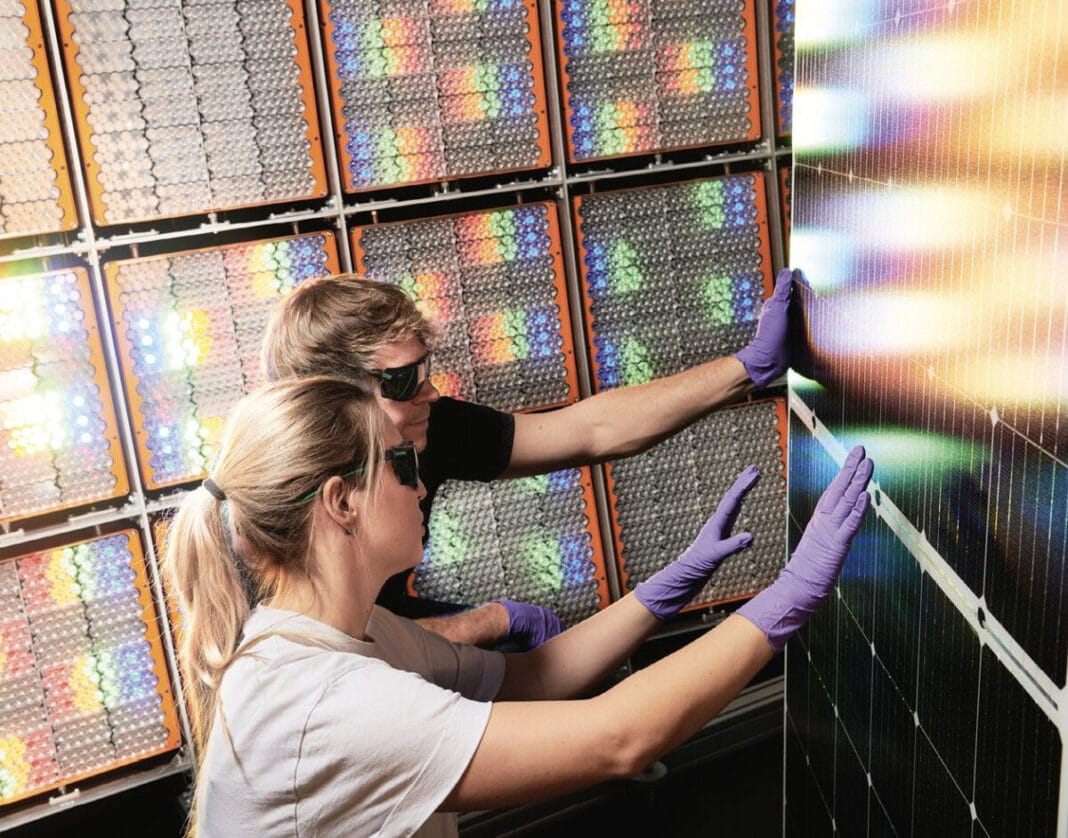
When the outcomes have been introduced, the Fraunhofer ISE staff famous that scientists from CalLab PV Modules’ calibration laboratory used a “multispectral photo voltaic simulator” to measure crystalline silicon photo voltaic cells and perovskite cells. This permits completely different gentle spectra to be utilized to the cell whereas below steady illumination. It requires particular measuring tools primarily based on LED gentle sources that may present gentle equal to 1.68 m of the module.2 above.
“The steady depth and spectral stability of the sunshine supply is of specific significance particularly for the tandem gadget,” stated Johnson Wong, basic supervisor for the Americas of the tools supplier Wavelabs. Researchers from Fraunhofer ISE used Wavelabs’ Sinus-3000 Advanced LED module IV tester for the Oxford PV module.
“Thanks to its optimized gentle distribution over a protracted working distance, the tester gentle supply is designed to supply a lightweight subject that intently mimics the solar at each level of the big module space ,” added Wong. He stated that the Sinus-3000 LED tester exceeded the A+ class by way of “spectrum, gentle uniformity, and stability over time, which play an vital position in measuring accuracy.”
Correct angle
Accurate characterization of perovskite photo voltaic gadgets requires not solely new tools but in addition new processes. An extended interval of illumination is required; the impact of temperature on the sunshine supply have to be managed or corrected; IV sweeps ought to be a lot slower than in crystalline silicon cells; and, in tandem cells, their present have to be adjusted in order that the mixed energy output will not be restricted.
The PV analysis neighborhood, future producers, and tools suppliers are taking steps to beat the formidable challenges posed by perovskite photo voltaic gadgets. New, collaborative analysis tasks have been launched and measurement routines grew to become extra refined. As a outcome, confidence is rising that as future PV perovskite producers develop their gadgets towards maturity, the tools and processes shall be prepared.
Sunny prospects
Karl Melkonyan, PV expertise analyst at S&P Global Commodity Insights, stated perovskite tandems have “the perfect probabilities for commercialization” amongst next-generation photo voltaic cell applied sciences. Perovskite PV cells will be mixed with both crystalline silicon (c-Si) or skinny movie photo voltaic cells.
Early perovskite PV gadgets achieved conversion efficiencies within the low single digits – 3.8% was recorded in 2008. Record efficiencies at the moment are set at common intervals of greater than 25% .
Perovskite tandem gadgets are extraordinarily promising, particularly as a result of the thin-film perovskite cell plus the “base” c-Si, cadmium telluride, or copper indium gallium selenide layer can seize completely different wavelengths of sunshine, which ends up in small analysis cells with efficiencies higher than 30 %.
However, translating lab effectivity to bigger cells and modules is troublesome. “While there are numerous file efficiencies achieved in perovskite photo voltaic cells that attain 20% and above, the general effectivity of a tandem construction will be a lot decrease than the sum of the person efficiencies,” stated Melkonyan. He famous that the reason for that is typically a present mismatch between the underside and prime cells.
Measurement challenges
For a PV gadget to show its price, its energy output have to be measured in a extremely correct, replicable, and standardized method. At the top of the day, when a PV module is bought and put in, it can be crucial that the ability output on the nameplate be dependable.
Here, because the current outcomes of Fraunhofer ISE and Oxford PV present, perovskite PV gadgets current many new challenges. “Yes, measuring the ability of a perovskite tandem or multi-junction cell presents challenges and will be troublesome as a result of particular spectrally-adjustable photo voltaic simulators are required,” stated Melkonyan. “Besides the suitable stabilization strategies for various perovskite supplies, the processes ought to embrace standardized protocols to measure below normal check circumstances.”
In late April 2024, Fraunhofer ISE, Oxford PV, Wavelabs, and the University of Freiburg concluded an 11-month investigation into how multi-format perovskite tandem PV cells will be precisely characterised. Fraunhofer ISE’s Martin Schubert is main the challenge – abbreviated to “Katana” in German. He stated there are two main variations between the habits of perovskite tandem gadgets and common PV modules.
Two causes
“One is that effectivity can change throughout illumination,” stated Schubert, who leads the standard assurance, characterization and simulation staff. “The cause for that’s that there’s an ion migration within the perovskite cell the place some ions transfer. The second complication is the tandem structure. By itself, meaning we’ve two photo voltaic cells – certainly one of above the opposite and have completely different spectral sensitivities.We must guarantee that the highest cell will get the correct amount of present and the underside cell will get the correct amount of present.
Ion migration inside the perovskite gadget whereas below steady illumination signifies that the measured effectivity can enhance or lower over time. This “metastability” requires the lengthy illumination time vital to find out the improved energy output. Further complicating issues, completely different perovskite PV compositions exhibit completely different ranges of metastability.
The want for lengthy publicity to gentle, to accommodate metastability, results in warmth, even when LEDs are used. This signifies that measurements of perovskite gadgets are sometimes carried out at temperatures increased than the usual check circumstances (STC).
The energy output of a photovoltaic gadget decreases as its temperature will increase, one thing described as a tool’s temperature coefficient. Different PV applied sciences imply completely different temperature coefficients. c-Si photo voltaic merchandise, for instance, have a bigger temperature coefficient than skinny movie gadgets. If that’s not managed and accounted for, the result’s measurement uncertainty.
Test tools with temperature management – a room with air-con – can cut back this uncertainty in the perfect eventualities. Such refined gadgets, particularly these of enough scale to accommodate total modules, come at a value.
The impact of temperature will be corrected for utilizing mathematical fashions primarily based on correct temperature readings and may trigger uncertainty to be carried over to increased temperatures. With tandem gadgets, the temperature sensitivity of the highest and backside cells have to be thought-about – a sophisticated, if not unattainable, equation.
Commercial implications
Currently, perovskite gadgets are examined in minutes, to account for the metastability related to ion migration within the perovskite cell, in order that slower IV sweeps, with a number of energy level monitoring (MPPT ), will be applied. It will not be appropriate for mass manufacturing, as many modules want to maneuver by means of the manufacturing strains each minute.
Wavelabs’ Wong stated {that a} “extra pragmatic check routine” would doubtless first contain a preconditioning of the module utilizing gentle soaking, from mass-production gentle sources. That can then be adopted by “a speedy IV sweep utilizing high-quality illumination that should match inside specs of spectral match, uniformity, and stability,” Wong says. “A quick IV sweep tends to be accomplished on the order of 100 milliseconds to a second, the place the ions are ‘frozen in’ their preconditioned distribution and turn into much less distributed.”
Fraunhofer ISE will launch a three-year analysis challenge in May 2024 that may examine how “quick and correct measurements” will be developed and applied for perovskite gadgets, together with tandems. The challenge, abbreviated to “PERLE” in German, shall be funded by Germany’s Federal Ministry of Economic Affairs and Climate Action. Fraunhofer ISE’s Schubert stated it’s attainable that the primary findings from the challenge shall be printed in May 2025.
This content material is protected by copyright and will not be reused. If you wish to cooperate with us and wish to reuse a few of our content material, please contact: [email protected].
[ad_2]
Source link